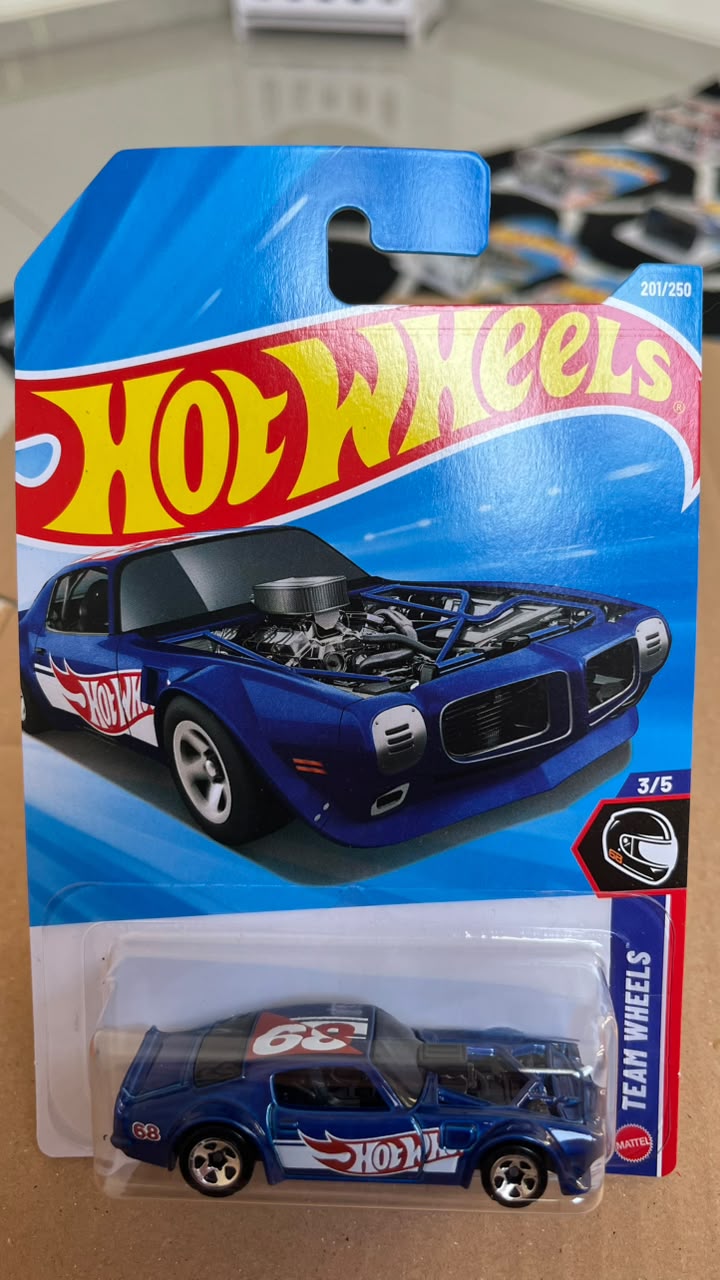
In the golden age of American muscle, few performance coupes blended raw displacement with European-inspired aerodynamic finesse as brilliantly as the Pontiac Firebird. When General Motors released the second-generation Firebird in early 1970, it was more than a mid-cycle redesign; it was a total stylistic departure from the traditional square-jawed pony cars of the late 1960s. The pinnacle of this lineup, the 1970 Pontiac Firebird Trans Am, became an instant road-and-track legend on the Trans-Am racing circuit. Hot Wheels immortalized this 1970s icon in 1:64 scale across both factory-spec castings and radical custom builds—most notably the Custom ’70 Chevy/Pontiac Firebird designed in collaboration with Hot Wheels Legends Tour winner Riley Stair. Today, it stands as a cornerstone collectible for muscle car purists around the globe.
A Brief History of a Second-Gen V8 Monster
To appreciate why the Hot Wheels 1970 Pontiac Firebird holds such a revered status among die-cast collectors, one must look back at the radical engineering and styling philosophy that birthed the original machine. Launched for the “1970 1/2” model year under the design leadership of Bill Mitchell, the second-gen Firebird shed its first-generation chrome bumpers for a sweeping, continuous body contour.
Housed beneath its long, sculpted hood sat a massive 400 cubic-inch (6.6-liter) Ram Air III V8 or the ultra-rare Ram Air IV V8 engine, generating up to 345 horsepower and a earth-shaking 430 lb-ft of torque. The hallmark visual feature was the functional rear-facing shaker hood scoop, which protruded directly through the hood and vibrated violently under heavy throttle. Paired with a Hurst 4-speed manual transmission, heavy-duty sway bars, and a tuned performance suspension package, the 1970 Trans Am was engineered to dominate both quarter-mile drag strips and twisty road courses with equal ferocity.
1:64 Scale Design Anatomy and Hot Wheels Tooling Precision
Hot Wheels has paid tribute to the 1970 Firebird using multiple distinct tooling executions, capturing both factory-fresh restorations and aggressive custom race builds with exceptional scale detail.
Endura Front Bumper & Dual Split Grille
The front profile of the 1970 Firebird casting is defined by its body-colored, energy-absorbing Endura front bumper, which cleanly frames Pontiac’s iconic dual split-grille layout. Deep-set circular headlights sit recessed within the front nose, giving the die-cast model a focused, aggressive, and aerodynamic front gaze.
Coke-Bottle Profile & Shaker Hood Assembly
Along the side profile, the Hot Wheels tooling captures the sweeping “coke-bottle” hip lines that arch over the rear wheel wells. The raised shaker hood scoop sits proudly atop the front bonnet. On factory Trans Am castings, small aero spats in front of the wheel wells and functional front fender vents are cleanly molded into the body shell.
Ducktail Rear Spoiler & Dual Exhausts
At the rear, the model features a sloping rear backlight that flows seamlessly into the short rear deck. The signature visual detail of the 1970 Trans Am is its three-piece integrated ducktail rear spoiler. Deeply recessed horizontal taillights span across the rear fascia above dual exhaust tips protruding from beneath the rear lower valance.
Exploring Release Variations: From Factory Stock to Riley Stair’s Custom
Throughout its run in the Hot Wheels catalog, the 1970 Pontiac Firebird has appeared in several memorable forms across multiple collector tiers:
Mainline Releases (Factory Spec)
In standard mainline drops, the 1970 Firebird is most famous in its official launch colorways: Polar White with a broad Lucerne Blue center racing stripe, or metallic Lucerne Blue with white striping. These factory-accurate liveries highlighted the clean, uncluttered lines of the early second-gen body shell paired with classic 5-spoke wheels.
Custom ’70 Pontiac Firebird (Hot Wheels Legends Tour)
One of the most famous modern interpretations is the Custom ’70 Pontiac Firebird, based on Riley Stair’s real-world custom build that won the 2020 Hot Wheels Legends Tour. This radical tooling features ultra-wide hand-fabricated box flares, a custom tubular chassis sitting millimeters off the ground, side-exit exhaust pipes dumping straight out of the front fenders, and a fully exposed, high-rpm V8 motor block sticking out of the hoodless engine bay. In Premium drops (such as Car Culture: Door Slammers or Boulevard), this casting gets a full metal body/metal chassis construction and rubber Real Riders tires.
Pop-Culture Fame and Global Collector Appeal
The everlasting appeal of the Hot Wheels 1970 Pontiac Firebird is strongly reinforced by the second-generation Firebird’s place in American cinematic history. The second-gen Firebird silhouette became a cultural phenomenon throughout the 1970s and 80s, serving as the quintessential hero car in Hollywood classics like Smokey and the Bandit and The Rockford Files.
In digital media and racing simulators, the 1970 Firebird Trans Am remains a fan-favorite vehicle across flagship video game franchises including Forza Horizon, Gran Turismo, and Need for Speed. Its virtual presence ensures that new generations of automotive enthusiasts continue to respect and admire the raw power and styling of 1970s Pontiac muscle.
For die-cast investors, the combination of peak 1970s muscle car heritage, the fame of the Hot Wheels Legends Tour custom build, and timeless styling gives the 1970 Firebird casting exceptional market stability. Sealed rubber-tired Premium releases and early Polar White mainline carded models routinely see strong, consistent demand on the secondary market.
Display, Preservation, and Care Guide
To keep your Hot Wheels 1970 Pontiac Firebird models looking factory-fresh while preserving their long-term collector value, following proper storage and display practices is recommended:
- Carded Storage (Mint on Card): If you keep your models sealed inside their original blister packaging, house them inside rigid, UV-resistant plastic clamshell protector cases. Keep your collection away from direct sunlight to prevent factory Polar White paint from yellowing and to keep the clear plastic blister bubble crystal-clear over time.
- Showcasing Loose Models: For collectors who enjoy displaying unboxed models, set them up inside dust-proof acrylic cases or glass cabinets. Grouping the 1970 Firebird alongside its historical Trans-Am racing rivals (such as the 1969 Chevrolet Camaro SS, Ford Mustang Boss 302, and 1970 Dodge Challenger R/T) creates a prestigious “Golden Era Trans-Am Legends” display theme.
- Routine Maintenance: Gently remove dust from the bodywork, exposed engine bays, and wide fender flares using a soft-bristled camera lens brush or an anti-static air blower. Avoid using chemical solvents, rubbing alcohol, or abrasive cloths, as these can easily damage or strip fine tampo-printed racing stripes and badges.
Why the 1970 Pontiac Firebird Belongs in Your Collection
For anyone passionate about collecting classic American performance cars, Trans-Am motorsport history, and iconic custom builds, the Hot Wheels 1970 Pontiac Firebird is an indispensable anchor piece. This model is far more than a simple 1:64 scale die-cast toy; it is a physical monument to a golden era when American muscle was bold, loud, and unapologetically fast. With its aggressive Endura front nose, iconic shaker hood, and sweeping coke-bottle silhouette, this V8 road-warrior guarantees your performance garage commands total respect.