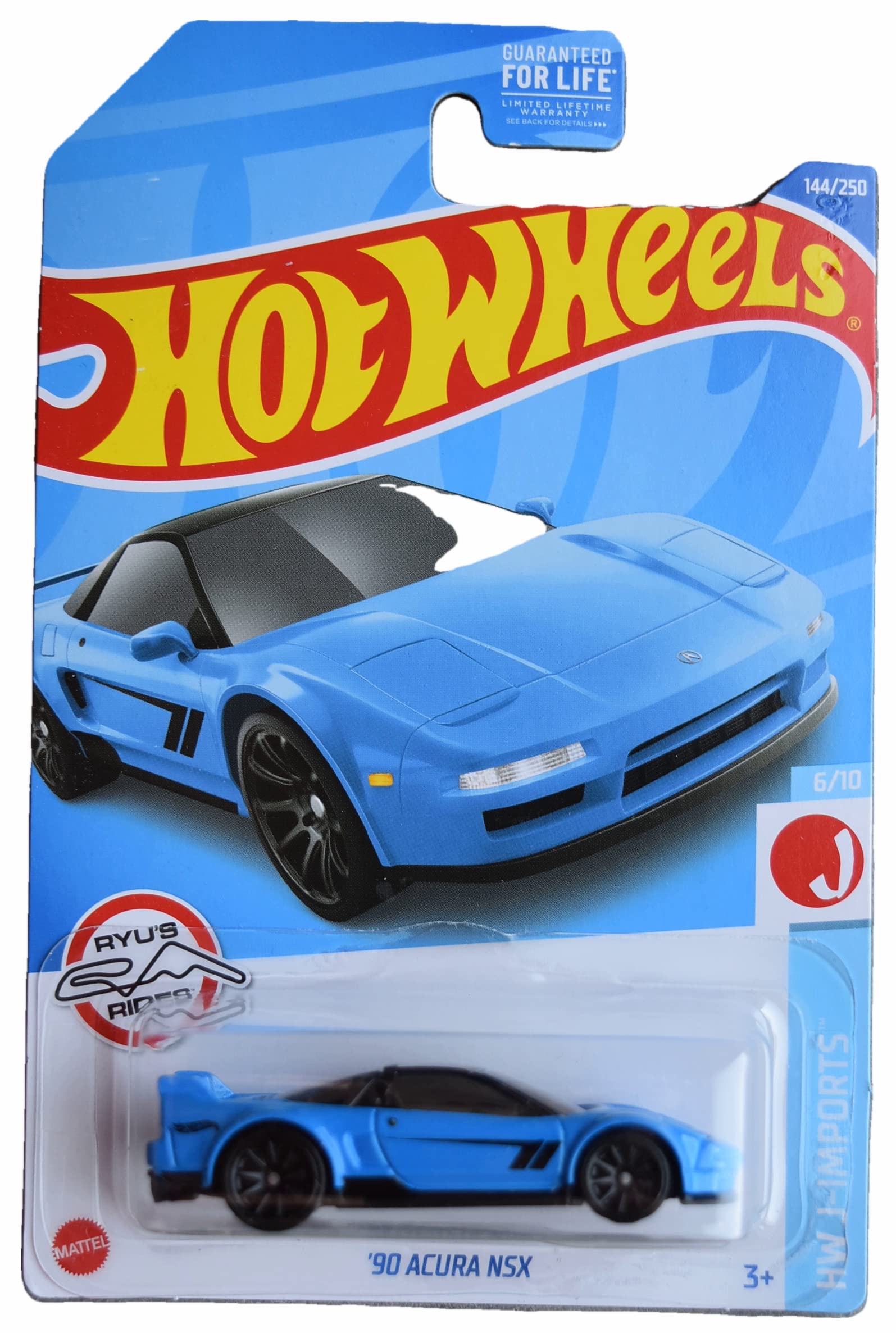
In the late 1980s, the exotic supercar landscape was dominated by European royalty like Ferrari and Lamborghini. That balance of power was permanently disrupted in 1989 when Honda unveiled a mid-engine masterpiece that fundamentally redefined what a supercar could be: the Honda NSX (New Sportscar eXperimental). Engineered to challenge the raw performance of the Ferrari 348 while offering Honda’s legendary daily reliability, the NSX was fine-tuned with direct chassis development from three-time Formula 1 World Champion Ayrton Senna. The result was the world’s first mass-production all-aluminum monocoque sports car—lightweight, perfectly balanced, and razor-sharp. Hot Wheels captured this exotic JDM icon in 1:64 scale with its ’90 Honda NSX casting (alongside custom NSX-R variations), sculpting a top-tier die-cast model revered by collectors around the world.
A Brief History of Honda’s Aluminum Supercar Giant-Killer
To understand why the Hot Wheels ’90 Honda NSX commands such deep respect among collectors, one must look at the revolutionary engineering behind the full-scale machine. Introduced for the 1990 model year (sold under the Acura badge in North America), the NSX was developed by a team led by Chief Engineer Shigeru Uehara, featuring a cockpit cabin silhouette inspired directly by the F-16 Falcon jet fighter.
Mounted behind the passenger cabin sat a 3.0-liter naturally aspirated V6 (C30A) engine equipped with Honda’s high-revving VTEC (Variable Valve Timing and Lift Electronic Control) system. Delivering 270 horsepower and screaming up to an 8,000 RPM redline, the mid-ship engine gave the lightweight aluminum chassis exceptional balance. During testing at the Suzuka Circuit and the Nürburgring, Ayrton Senna famously pushed the prototype to its limits, advising engineers to increase chassis stiffness by 50%. This input transformed the NSX into a track-proven giant-killer capable of shaming European exotics at a fraction of their maintenance cost.
1:64 Scale Design Anatomy and Ryu Asada’s Tooling Mastery
Translating the low wedge stance, black glass canopy, and integrated rear wing of the first-generation NSX into a 1:64 scale model required master-level design. Hot Wheels entrusted the ’90 Honda NSX tooling to the late, legendary designer Ryu Asada, who captured the car’s authentic proportions upon its 2015 debut.
Low-Slung Front Wedge & Pop-Up Headlamp Seams
The front profile of the Hot Wheels ’90 Honda NSX features an ultra-low nose anchored by crisp panel lines defining the retracted pop-up headlamp covers. The lower front valance incorporates subtle brake cooling intakes and horizontal turn signal lenses.
F-16 Jet Fighter Canopy & Side Air Inlets
Along the flanks, Ryu Asada’s tooling replicates the iconic black roof canopy that glides smoothly over the cockpit, echoing the canopy of a fighter jet. Deeply recessed side air scoops behind the doors route fresh air directly into the mid-mounted V6 engine bay. On premium variants, the model features soft Real Riders rubber tires wrapped around authentic JDM multi-spoke rims.
Integrated Rear Wing & Full-Width Taillight Bar
At the rear, the model showcases the defining visual signature of the NA1 generation: an integrated rear wing that flows seamlessly out of the rear quarter panels. Positioned beneath the spoiler is a full-width horizontal taillight bar complete with micro-printed Acura or Honda badging, anchored by dual exhaust tips protruding from the rear valance.
Exploring Release Variations: From Championship White to NSX-R Drops
Since making its initial debut in the 2015 Hot Wheels lineup, the ’90 Honda NSX casting has appeared across a wide spectrum of factory-correct liveries and high-tier collector editions:
Factory-Correct Launch Liveries
In mainline and premium releases, the NSX frequently appears in Honda’s most iconic motorsport colors: Championship White with color-matched white rims, as well as the launch-spec Formula Red paired with a contrasting black canopy roof. Other factory shades include Sebring Silver, Berlina Black, and Indy Yellow Pearl.
Dedicated NSX-R (Type R) Variations
Hot Wheels expanded the lineup with track-focused variations, including the ’96 Honda NSX-R and custom tuner iterations. The NSX-R tooling replicates the lightweight factory spec, featuring a vented carbon-fiber hood, a raised rear wing, and detailed interior casting highlighting red Recaro bucket seats.
Premium Car Culture & Super Treasure Hunt Drops
When elevated to adult collector series—such as Car Culture: Japan Historics, Door Slammers, and Street Tuners—the NSX receives full metal body/metal chassis construction (metal/metal) and high-resolution micro-tampo graphics. The coveted 2016 Super Treasure Hunt (STH) variant remains an absolute holy grail, finished in brilliant Spectraflame paint with Real Riders rubber tires.
Pop-Culture Fame and Blue-Chip Collector Appeal
The global obsession surrounding the Hot Wheels ’90 Honda NSX stems from its historic role in reshaping supercar history. By proving that an exotic mid-engine machine could be reliable, user-friendly, and devastatingly fast, the NSX forced rivals like Ferrari and Porsche to dramatically improve their build quality and ergonomics for all subsequent generations.
In digital entertainment and video games, the NSX holds a permanent flagship slot across major franchises including Gran Turismo, Need for Speed, Forza Horizon, and Initial D (driven by Go Hojo). Its virtual presence keeps real-world and die-cast enthusiasm sky-high across generations.
For die-cast investors, the ’90 Honda NSX represents a blue-chip JDM asset. Rare variants—such as the Super Treasure Hunt edition, early Japan Historics releases, unpainted ZAMAC drops, and the debut 2015 HW Workshop carded releases—demonstrate rock-solid market stability and continuous long-term value appreciation.
Display, Preservation, and Care Guide
To keep your Hot Wheels ’90 Honda NSX models looking pristine while protecting their long-term collector value, following proper storage and care practices is recommended:
- Carded Storage (Mint on Card / STH): If you store high-value models sealed inside their original blister packaging, house them inside rigid, UV-resistant plastic clamshell protector cases. Keep carded models away from direct sunlight to prevent delicate Championship White or Spectraflame paint finishes from yellowing or fading over time.
- Showcasing Loose Models: For collectors displaying unboxed models, set them up inside dust-proof acrylic display cabinets illuminated by cool LED lighting. Displaying the ’90 Honda NSX alongside other 1990s JDM legends (such as the Nissan Skyline GT-R R34, Toyota Supra MK4, and Mazda RX-7 FD3S) creates a world-class “Golden Era of JDM Supercars” display theme.
- Routine Maintenance: Gently remove ambient dust from the bodywork, rear wing channels, and wheel spokes using a soft-bristled camera lens brush or an anti-static air blower. Avoid using chemical solvents or alcohol-based cleaners, as these can easily strip fine micro-tampo taillight graphics and clear-coat finishes.
Why the ’90 Honda NSX Belongs in Your Die-Cast Collection
For anyone passionate about collecting exotic JDM legends, honoring Ayrton Senna’s motorsport development legacy, and celebrating revolutionary mid-engine engineering, the Hot Wheels ’90 Honda NSX is an indispensable centerpiece. This model is far more than a simple 1:64 scale toy; it is a physical monument to a landmark achievement—proving that Japanese engineering could conquer the supercar world without sacrificing daily usability. With its jet-fighter canopy, integrated rear wing, and Ryu Asada’s master tooling, this aluminum monarch guarantees your die-cast garage commands total respect.