Among the pantheon of Japanese sports cars that defined the golden era of the Japanese Domestic Market (JDM) in the 1990s, none possessed a silhouette as breathtakingly elegant or mechanically unique as the third-generation Mazda RX-7 (FD3S). Designed with an unwavering focus on lightweight agility and timeless organic curves, the FD3S was far more than just a high-performance sports car—it was a rolling piece of modern art. By pairing a wind-tunnel-sculpted body, pop-up headlights, and the distinctive high-rpm scream of a twin-turbocharged Wankel rotary engine, the RX-7 transcended the automotive world to become a global pop-culture phenomenon. Hot Wheels immortalized this Japanese legend in 1:64 scale with its ’92 Mazda RX-7 casting, sculpting a top-tier die-cast model that remains one of the most coveted JDM releases in the brand’s catalog.
A Brief History of a Twin-Turbo Rotary Masterpiece
To understand why the Hot Wheels ’92 Mazda RX-7 ignites such deep passion among die-cast collectors, one must look at the groundbreaking mechanical philosophy behind the full-scale automobile. Unveiled in late 1991 for the 1992 model year, the FD3S represented the absolute peak of Mazda’s RX-7 lineage, penned under the design leadership of Tom Matano and Yoichi Sato.
Unlike its rivals relying on heavy, traditional piston engines, Mazda outfitted the RX-7 with a compact 1.3-liter 13B-REW twin-rotor Wankel rotary engine. It was the first mass-produced sequential twin-turbocharged engine system to emerge from Japan. Delivering 252 horsepower in its debut trim (and rising in later iterations), the remarkably small engine sat low and far back in the engine bay, granting the car a perfect 50:50 front-to-rear weight distribution and an ultra-low center of gravity. Coupled with a double-wishbone suspension at all four corners, the FD3S earned a legendary reputation for razor-sharp handling on mountain passes (touge) and race circuits worldwide.
1:64 Scale Design Anatomy and Ryu Asada’s Sculpting Genius
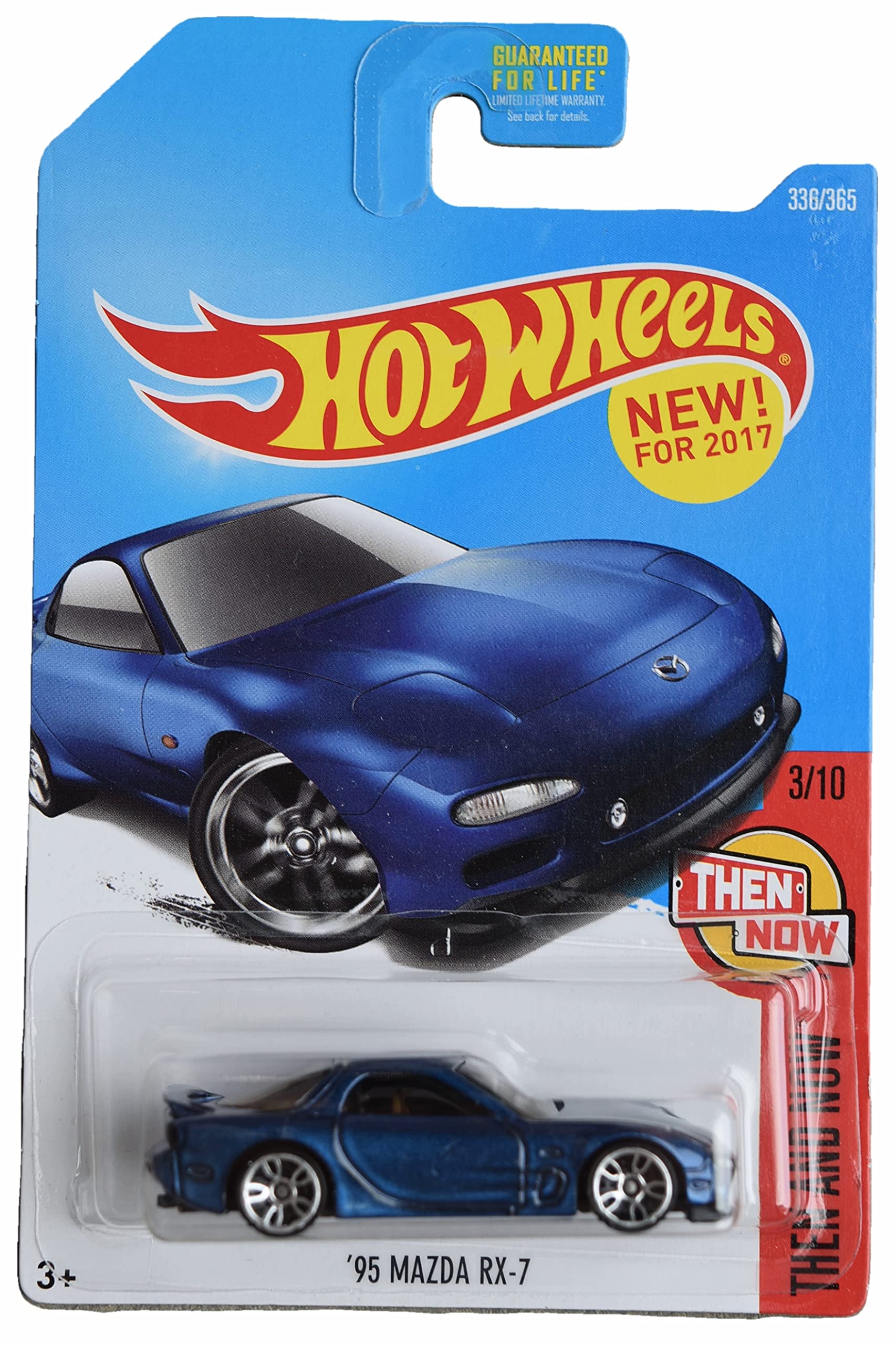
Translating the organic, fluid curves, pop-up headlight seams, and signature long-hood/short-deck proportions of the FD3S into a 1:64 scale model required master-level design. Hot Wheels entrusted the ’92 Mazda RX-7 casting to the late, legendary designer Ryu Asada, who executed the car’s authentic proportions with absolute mastery upon its 2017 debut.
Low-Slung Front Fascia & Pop-Up Headlights
The front profile of the Hot Wheels ’92 Mazda RX-7 features a sharply merunduk nose anchored by a subtle oval air intake tucked into the lower valance. Crisp panel lines define the retracted pop-up headlight covers molded cleanly into the hood. The front bumper is complete with recessed indicator light lenses flanking the center intake.
Seamless Side Profile & Flush Pillar-Mounted Door Handles
Along the flanks, Ryu Asada’s tooling captures the unblemished, flowing shoulder lines that flow continuously without harsh angles. A subtle yet iconic detail on the FD3S is the vertical door handle mounted flush into the B-pillar, which Hot Wheels replicated with pin-sharp detail. On premium releases, the casting is fitted with soft Real Riders rubber tires wrapped around JDM-style 5-spoke wheels.
Full-Width Smoked Taillight Bar & Factory Rear Wing
At the rear, the model features the most recognizable visual element of the FD3S: the horizontal, full-width smoked taillight array. A factory-style rear spoiler arches elegantly over the glass rear hatch, while a single performance exhaust tip exits cleanly from beneath the rear bumper.
Exploring Release Variations: From Factory Red to Pandem Widebody Drops
Since debuting in the 2017 Hot Wheels lineup, the ’92 Mazda RX-7 casting has appeared in a wide array of stunning colorways and custom body variations:
Factory-Correct Mainline Drops
In its debut 2017 Then and Now mainline release, the car was introduced in factory-correct Vintage Red—the signature launch color that adorns official 1992 showroom posters. Subsequent mainline releases appeared in purist factory shades including Brilliant Black, Sunburst Yellow, Pewter Metallic, and Daytona Blue.
Custom Pandem Widebody & Drift Variants
Beyond the pristine factory body, Hot Wheels expanded the RX-7 family with aggressive custom toolings. The Custom ’92 Mazda RX-7 features a widebody kit designed in collaboration with Keita Miura’s Tra Kyoto (Pandem), complete with massive bolt-on fender flares, a front splitter, and a tall ducktail rear wing. Additionally, Hot Wheels produced the Madaz / Mad Mike RX-7 Drift variant, honoring New Zealand drift legend Mad Mike Whiddett.
Premium Car Culture & Super Treasure Hunt Drops
When elevated to adult collector tiers—such as Car Culture: Japan Historics 2, Street Tuners, and Door Slammers—the RX-7 received full metal body/metal chassis construction and ultra-sharp micro-tampo details. The coveted 2020 Super Treasure Hunt (STH) variant remains an absolute holy grail, finished in stunning Spectraflame Copper/Orange paint with Real Riders rubber tires.
Pop-Culture Immortality and Blue-Chip Collector Status
The global obsession surrounding the Hot Wheels ’92 Mazda RX-7 is deeply tied to its status as a central hero vehicle in global pop culture. The FD3S achieved legendary status as the flagship drive of Keisuke Takahashi in the iconic anime/manga series Initial D, as well as Han Lue’s famous VeilSide-equipped RX-7 in Hollywood’s The Fast and the Furious: Tokyo Drift.
In digital entertainment, the FD3S holds a permanent flagship slot across major video game franchises including Gran Turismo, Need for Speed, and Forza Horizon. Its prominence in virtual racing keeps enthusiasm for real-world and die-cast models sky-high across generations.
For die-cast investors, the ’92 Mazda RX-7 represents a blue-chip JDM asset. Rare variants—such as the Super Treasure Hunt edition, early Car Culture releases, unpainted ZAMAC drops, and the debut 2017 Vintage Red mainline—demonstrate rock-solid market stability and continuous value appreciation on the secondary market.
Display, Preservation, and Care Guide
To keep your Hot Wheels ’92 Mazda RX-7 models looking pristine while protecting their long-term collector value, following proper care and display practices is recommended:
- Carded Storage (Mint on Card / STH): If you store your high-value models sealed inside their original blister packaging, house them inside rigid, UV-resistant plastic clamshell protector cases. Keep carded models away from direct sunlight to prevent delicate Vintage Red or Spectraflame paint finishes from fading over time.
- Showcasing Loose Models: For collectors displaying unboxed models, set them up inside dust-proof acrylic display cabinets illuminated by cool LED lighting. Displaying the ’92 Mazda RX-7 alongside other 1990s JDM icons (such as the Nissan Skyline GT-R R34, Toyota Supra MK4, and Honda NSX) creates a world-class “Golden Era of JDM Legends” display theme.
- Routine Maintenance: Gently remove ambient dust from the bodywork, rear wing channels, and wheel spokes using a soft-bristled camera lens brush or an anti-static air blower. Avoid using chemical solvents or alcohol-based cleaners, as these can easily damage fine micro-tampo taillight graphics and clear-coat finishes.
Why the ’92 Mazda RX-7 Belongs in Your Collection
For anyone passionate about collecting JDM legends, honoring the engineering heritage of the Wankel rotary engine, and celebrating timeless 1990s sports car design, the Hot Wheels ’92 Mazda RX-7 is an indispensable centerpiece. This model is far more than a simple 1:64 scale toy; it is a physical monument to one of the most creative and soul-stirring eras in automotive history. With its flawless organic stance, pop-culture fame, and Ryu Asada’s master tooling, this rotary queen guarantees your die-cast JDM garage commands total respect.