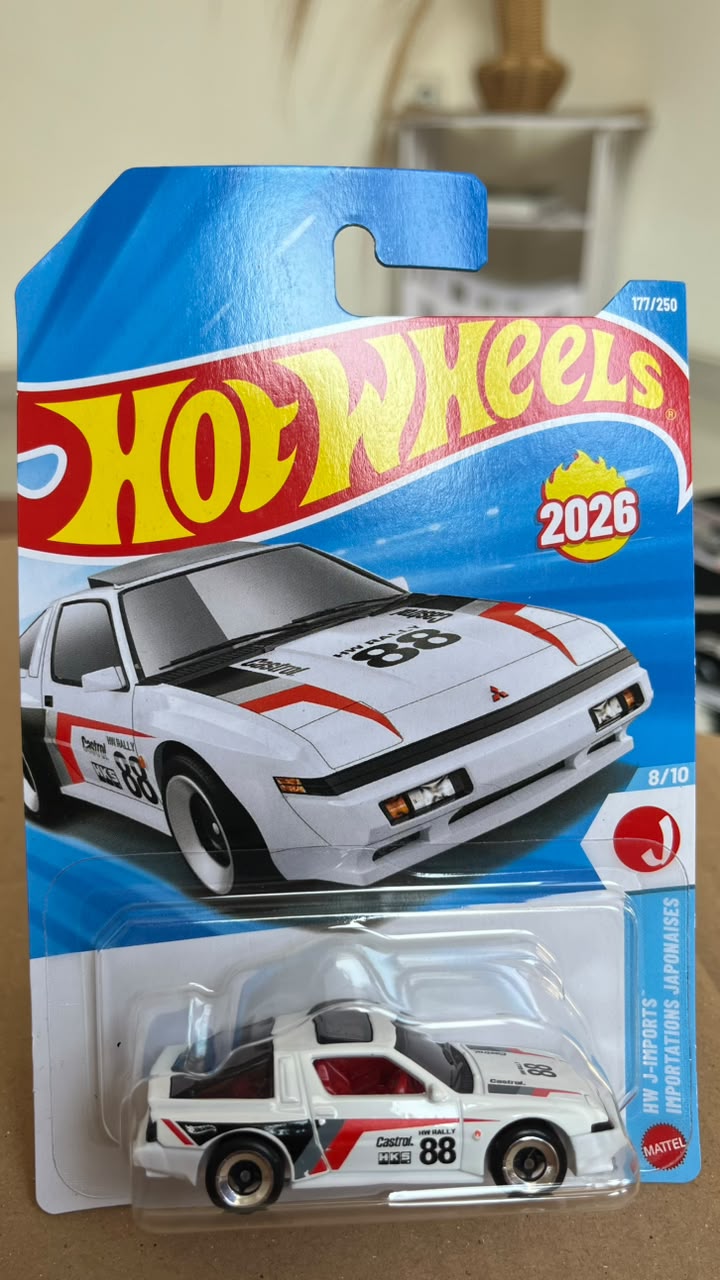
While the legendary Lancer Evolution series often dominates discussions of Mitsubishi’s performance history, true Japanese automotive purists reserve a sacred place for the 1980s icon that paved the way for the brand’s global motorsport dominance. First introduced in 1982, the Mitsubishi Starion was Tokyo’s bold, aggressive answer to the turbocharged Grand Tourer (GT) wars. The absolute zenith of the Starion lineage arrived with the widebody variants of the late 1980s—most notably the 1988 model year (E-A183A), known in North America as the Starion ESI-R (and its twin, the Chrysler/Dodge/Plymouth Conquest TSi). With its broad-shouldered geometric lines, aggressive box-flared fenders, and raw rear-wheel-drive dynamics, the Starion stands as one of the most influential Japanese sports coupes of the synthwave era. Sculpted by the late, revered Hot Wheels designer Ryu Asada, the ’88 Mitsubishi Starion brings this retro classic to 1:64 scale with remarkable fidelity, earning it a prized spot among JDM die-cast collectors worldwide.
A Brief History of Mitsubishi’s Turbocharged Trailblazer
To understand why the Hot Wheels ’88 Mitsubishi Starion commands such immense respect on retail pegs, one must look back at the technological leap forward the full-scale machine brought to the 1980s. Designed to challenge established rivals like the Toyota Celica Supra, Nissan 300ZX, and Mazda RX-7, the widebody Starion combined raw boosted power with advanced handling electronics.
Housed beneath its long, wedge-shaped hood sat the 4G54 2.6-liter intercooled turbocharged four-cylinder engine. In 1988 specification, this powerplant delivered an impressive 188 horsepower and 223 lb-ft of torque—staggering performance metrics for a four-cylinder motor in that era. Power was sent exclusively to the rear wheels via a 5-speed manual transmission mated to a factory Limited Slip Differential (LSD). Supported by four-wheel independent suspension and early ABS technology, the ’88 Starion possessed blistering straight-line speed and sharp, responsive cornering dynamics.
1:64 Scale Design Anatomy and Hot Wheels Tooling Precision
Translating the razor-sharp, boxy, and distinctly 1980s wedge silhouette of the Starion into a miniature model measuring just roughly three inches long required exceptional execution from Hot Wheels tooling engineers. Hot Wheels captured the widebody hatchback coupe proportions with striking authenticity.
Front Fascia & Retractable Pop-Up Headlights
The front end of the casting is anchored by a needle-sharp, chisel-nosed front bumper featuring closed pop-up headlight covers. Key visual details of the ’88 Starion’s front profile include the asymmetrical hood scoop intake and a low-slung front chin spoiler. High-resolution tampo graphics apply the horizontal indicator light lenses and grille trim with crisp precision.
Side Profile & Muscular Box-Flared Fenders
Along the side profile, the Hot Wheels tooling faithfully replicates the prominent box-flared widebody fenders that define the late-model Starion. These broadened wheel arches give the model a planted, aggressive stance that sits low over its axles. Clean, straight character lines run unbroken from the front quarter panels to the rear decklid, emphasizing the timeless retro aesthetic.
Hatchback Rear & Three-Piece Rear Spoiler
At the rear, the model features the sloping hatchback glass crowned by an integrated, three-piece rear wing assembly. The large horizontal taillight housings are applied with multi-color tampo detail, complete with subtle Mitsubishi diamond badging or “Starion ESI-R” text. A single exhaust tip protrudes beneath the rear bumper valance, completing an authentic 1980s tuner profile from every angle.
Exploring Release Variations: From Mainlines to Car Culture Premium
Since making its debut in the Hot Wheels lineup, the ’88 Mitsubishi Starion casting has moved across multiple release tiers, consistently serving as a standout model in every assortment.
Mainline Releases
In its mainline appearances, the Starion was showcased in factory-correct period colors, including Fiery Red and Satin Silver. These clean liveries did a phenomenal job of highlighting the contrast between the vibrant body paint and the black bumper accents, paired with classic 5-spoke plastic wheels. The initial mainline drops disappeared from retail pegs almost instantly as collectors scrambled to secure the new tooling.
Premium Series (Car Culture: Modern Classics)
When elevated to adult collector assortments—such as Car Culture: Modern Classics—the ’88 Starion receives a complete technical overhaul. Premium variants feature a heavy full-metal body and chassis construction (metal/metal) that offers a satisfying weight in hand. The addition of authentic Real Riders rubber tires mounted on four- or five-spoke retro tuner rims (mirroring the factory staggered alloy wheels) transforms the model into a museum-grade display piece. Fine details like window trim, side markers, and badging are applied with incredible sharpness.
Pop-Culture Legacy and Global Collector Appeal
The global hype surrounding the Hot Wheels ’88 Mitsubishi Starion is heavily reinforced by its ties to Hollywood action cinema and modern digital gaming culture. Movie buffs fondly remember the Starion from its starring role in the classic 1984 film The Cannonball Run II, where a high-tech Starion was piloted by Jackie Chan and Richard Kiel, equipped with rocket thrusters and digital HUD displays.
In digital entertainment, the widebody Starion holds a strong presence across flagship racing franchises like Gran Turismo, Forza Horizon, and Need for Speed. Its inclusion in modern racing simulators ensures that younger generations of car enthusiasts continue to recognize the Starion as a cornerstone of Japanese sports car history.
For die-cast investors, the historical significance of the Starion combined with its rare 1980s widebody styling gives this casting fantastic market liquidity and value stability. Sealed rubber-tired Premium releases and early mainline colorways routinely maintain strong collector interest on the secondary market.
Display, Preservation, and Care Guide
To keep your Hot Wheels ’88 Mitsubishi Starion models looking pristine while maintaining their long-term collector value, following proper storage and display practices is recommended:
- Carded Storage (Mint on Card): If you prefer keeping your models sealed inside their original blister packaging, house them inside rigid, UV-resistant plastic clamshell protector cases. Keep your collection away from direct sunlight to prevent factory paint colors from fading and to keep the clear plastic blister bubble from yellowing over time.
- Showcasing Loose Models: For collectors who enjoy displaying unboxed models, place them inside dust-proof acrylic cases or glass cabinets. Grouping the ’88 Starion alongside other 1980s Japanese performance icons (such as the ’82 Toyota Supra, Mazda RX-7 FC, and Nissan 300ZX) creates a prestigious “Golden Era 80s JDM” display theme.
- Routine Maintenance: Gently remove ambient dust using a soft-bristled camera lens brush or an anti-static blower. Avoid using chemical solvents, rubbing alcohol, or abrasive microfiber cloths, as these can easily damage or strip the fine tampo graphics and clear coat finish.
Why the ’88 Mitsubishi Starion Belongs in Your Die-Cast Collection
For anyone passionate about collecting Japanese performance heritage and vintage 1980s sports coupes, the Hot Wheels ’88 Mitsubishi Starion is an indispensable anchor piece. This model is far more than a simple 1:64 scale die-cast toy; it is a physical monument to one of the boldest, most muscular designs ever produced by Mitsubishi. With its broad-shouldered widebody footprint, retro pop-up headlights, and rich turbocharged lineage, this classic casting guarantees your performance garage commands total respect.