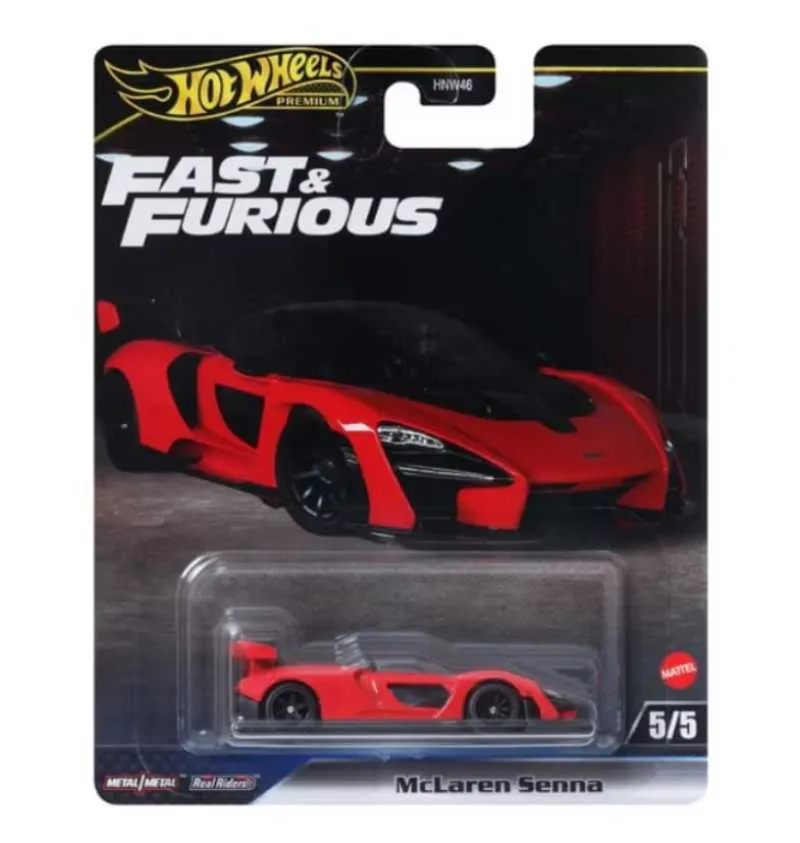
When the name of the late Formula 1 legend Ayrton Senna is officially bestowed upon a road-legal machine, automotive expectations instantly reach historic heights. McLaren Automotive embraced that monumental challenge in 2018 by unveiling the McLaren Senna, an uncompromised, track-focused hypercar anchoring the brand’s flagship Ultimate Series. Engineered with a single-minded philosophy—sacrificing daily comfort in pursuit of the fastest circuit lap times technically possible for a road-going vehicle—the Senna stands as a triumph of modern engineering. Hot Wheels captured the radical aerodynamics and aggressive footprint of this Woking-built land missile in 1:64 scale with remarkable precision, creating one of the most sought-after modern hypercar castings in die-cast collecting history.
A Tribute to an F1 Icon
To fully appreciate why the Hot Wheels McLaren Senna creates such an intense stir among die-cast collectors, one must dive into the extreme engineering philosophy behind the full-scale machine. Produced in a strictly limited run of just 500 units at the McLaren Production Centre in Woking, England, every single unit was spoken for long before the car made its official public debut.
At its core sits a ultra-lightweight Monocage III carbon-fiber tub housing a 4.0-liter twin-turbocharged V8 engine (coded M840TR). This mechanical powerhouse channels a staggering 789 horsepower and 590 lb-ft of torque directly to the rear wheels via a 7-speed dual-clutch transmission. Weighing in at a featherweight dry curb weight of just 2,641 lbs (1,198 kg), the Senna launches from 0 to 60 mph in a blistering 2.7 seconds and achieves a top speed of 208 mph. However, the Senna’s true capability lies not merely in straight-line acceleration, but in its ability to generate an astonishing 1,763 lbs (800 kg) of aerodynamic downforce at 155 mph through its active aero channels.
1:64 Scale Design Anatomy and Hot Wheels Tooling Precision
Translating the McLaren Senna’s complex array of air intakes, jet-inspired glass canopy, and massive rear wing into a miniature die-cast model measuring just a few inches long required exceptional tooling accuracy from Hot Wheels designers. The real-world car follows an uncompromising “form follows function” design language where every panel is sculpted purely to manipulate airflow. Hot Wheels captured these radical scale proportions with impressive skill.
Front Fascia & Carbon-Fiber Splitter
The front end of the casting is anchored by a massive, ground-hugging front splitter array. The narrow, aggressive headlight housings are integrated smoothly alongside functional front air blades. The aluminum-look hood features deep central channels and twin heat extractors designed to route air out from the front radiators, creating an intimidating, track-focused gaze.
Side Profile & Glazed Door Panels
Along the side profile, Hot Wheels sculpted the dramatic side air intakes engineered to feed cold air directly into the mid-mounted V8 engine. One of the most distinctive features of this casting is Hot Wheels’ effort to replicate the real car’s iconic dihedral doors, which feature clear glass lower panels. The sweeping roofline incorporates a functional roof scoop feeding fresh air into the intake plenum.
Rear Deck and Active Rear Wing
At the rear, the model features a massive, high-mounted active rear wing molded cleanly into the rear quarter structure. The rear bumper is dominated by a deep lower diffuser assembly alongside a distinctive triple-exit exhaust array angled upward toward the wing. The razor-thin horizontal LED taillights are applied using high-resolution tampo graphics, completing an authentic circuit-racer aesthetic from every angle.
Exploring Release Variations: From Mainlines to Premium
Since its initial debut in the Hot Wheels lineup in 2019, the McLaren Senna casting has appeared across multiple release tiers, serving as a standout model in every assortment.
Mainline Releases
In its mainline debut (within the HW Exotics series), the Senna appeared in the factory reveal colorways: Victory Grey accented with McLaren Orange highlights, followed by a brilliant Miraflores Blue finish. These vibrant shades did a phenomenal job of highlighting the car’s complex surface cuts and contrasting carbon-fiber aero components. The initial mainline drops remain highly prized by collectors seeking the launch-spec aesthetic.
Premium Series (Car Culture & Exotic Envy)
When elevated to adult collector series like Car Culture: Exotic Envy, the casting undergoes a thorough technical upgrade. Premium variants feature a heavy full-metal body and chassis construction that delivers a satisfying, substantial weight in hand. The addition of authentic Real Riders rubber tires mounted on detailed ultra-lightweight alloy replica wheels transforms the model into a true display piece. Fine details like McLaren badging, carbon-weave accents, and headlight lenses are applied with exceptional sharpness.
Pop-Culture Legacy and Global Collector Appeal
The massive global hype surrounding the Hot Wheels McLaren Senna is heavily reinforced by its high-profile presence in gaming and entertainment. The Senna was selected as the flagship hero cover car for the blockbuster video game Forza Horizon 4. Its dominant presence in digital racing culture introduced the hypercar to millions of young car enthusiasts around the world, cementing its status as an instant automotive legend.
For die-cast investors, the historical weight of the Senna name combined with the car’s extreme design gives this casting fantastic market liquidity and long-term value stability. Early mainline colorways and rubber-tired Premium releases consistently maintain strong collector interest on the secondary market.
Display, Preservation, and Care Guide
To keep your Hot Wheels McLaren Senna models looking pristine while maintaining their long-term value, following proper storage and display practices is recommended:
- Carded Storage (Mint on Card): If you prefer to keep your models sealed inside their original blister packaging, always house them inside high-grade, UV-resistant plastic protector cases. Keep your collection away from direct sunlight to prevent the vibrant paint finishes from fading and to keep the clear plastic blister bubble from discoloring over time.
- Showcasing Loose Models: For collectors who enjoy displaying unboxed models, house them inside dust-proof acrylic cases or glass cabinets. Grouping the Senna alongside other McLaren performance icons—such as the McLaren P1, 720S, or Speedtail—creates a prestigious “McLaren Ultimate Series” display theme.
- Routine Cleaning: Remove ambient dust from loose models using a soft-bristled camera lens brush or an anti-static microfiber cloth. Avoid using harsh chemical cleaners or abrasive materials, as these can strip away delicate tampo graphics and scratch the clear coat finish.
Why the McLaren Senna Belongs in Your Die-Cast Collection
For anyone passionate about collecting extreme automotive engineering and motorsport heritage, the Hot Wheels McLaren Senna is an essential anchor piece. This model is far more than just a miniature toy; it is a physical monument to one of the greatest racing drivers in human history, manifested in the form of a 21st-century track hypercar. With its muscular footprint, iconic rear wing, and rich racing pedigree, this high-octane casting guarantees your 1:64 scale performance garage commands total respect.